

How Cashback Really Works and Why It Is Different From Traditional Bonuses
A cashback bonus is one of the few casino incentives that I consider structurally honest. It does not promise upside before play begins, and it does not interfere with wagering decisions mid-session. Instead, cashback acknowledges what already happened. Losses are calculated first, and only then is compensation applied. That sequencing matters.
At Villento Casino, cashback bonuses are positioned as a stabilising mechanism rather than a marketing hook. You can enter the platform through Login, play normally without activating any promotion, and still qualify for cashback later depending on the offer terms. Cashback does not require impulsive commitment at Sign up, nor does it force players into narrow game choices inside Slots or Games.
What a Cashback Bonus Actually Is
Cashback is a partial refund of net losses over a defined period. That period may be daily, weekly, or campaign-based. The key word here is net. Wins are subtracted before cashback is calculated.
Example logic:
- Total wagers: $1,000
- Total wins: $850
- Net loss: $150
- Cashback rate: 10%
- Cashback credited: $15
This structure makes cashback predictable and easy to evaluate.
Why Cashback Is Treated Differently Than Other Bonuses
Unlike match bonuses or free spins, cashback is not activated upfront. It does not inflate balance or impose wagering pressure during play. That is why many experienced players prefer cashback to headline Bonus offers.
Core differences:
| Feature | Cashback Bonus | Deposit Bonus |
|---|---|---|
| Applied timing | After play | Before play |
| Wagering pressure | Low | Medium–High |
| Game restrictions | Minimal | Often strict |
| Psychological impact | Stabilising | Stimulating |
Cashback rewards consistency rather than risk-taking.
When Cashback Bonuses Are Applied
Cashback at Villento Casino typically applies under clearly defined windows. Common structures include:
- daily cashback on net losses
- weekly cashback summaries
- campaign-based cashback for specific activity
- loyalty-tier cashback for regular players
Importantly, cashback does not prevent access to other features. You can still use the App, play across Games, or switch between Slots freely while cashback eligibility is calculated in the background.
Typical Cashback Parameters
| Parameter | Description |
|---|---|
| Cashback rate | Percentage of net losses |
| Time frame | Daily / weekly / campaign |
| Minimum loss | Threshold before cashback applies |
| Maximum cap | Upper limit of cashback |
| Wagering on cashback | Often low or none |
This transparency makes cashback easy to assess before play begins.
Cashback and Wagering Requirements
One of the main advantages of cashback bonuses is reduced wagering pressure. In many cases, cashback funds either:
- have very low wagering (e.g. x1–x5), or
- are credited directly as withdrawable cash
This makes cashback fundamentally different from traditional bonuses that may require x30–x40 wagering.
That distinction is why cashback bonuses are often recommended for players who prioritise control over volatility.
Cashback Effect on Net Losses
Cashback works best when sessions are planned rather than reactive.
Cashback Across Devices
Cashback calculations are not affected by device choice. Whether you play via desktop browser or mobile App, wagers are tracked identically. There are no hidden differences in eligibility, rates, or caps.
This consistency reinforces trust and reduces disputes.
Behavioural Impact of Cashback
From a behavioural standpoint, cashback slightly reduces loss aversion without encouraging excessive play. Because it is calculated after the fact, it does not push players to increase stakes or extend sessions artificially.
This is why cashback is often highlighted in responsible gambling discussions.
When Cashback Is Not Ideal
Cashback is less effective when:
- sessions are extremely short
- play focuses on single high-volatility games
- losses are minimal
In these cases, cashback may not reach the minimum threshold to apply.
Strategic Perspective
I treat cashback as insurance, not profit. It softens variance but does not change the underlying math of games. Players who understand this tend to use cashback calmly rather than emotionally.
Cashback is most valuable when you plan to play anyway — not when it becomes the reason to play.
How Cashback Is Calculated in Practice
Cashback is always based on net losses, not on total wagers. This distinction removes ambiguity and prevents inflated expectations.
A typical calculation window works like this:
- all wagers are tracked during the defined period
- all wins are subtracted from wagers
- the remaining loss becomes the cashback base
If the net result is zero or positive, no cashback is generated.
| Metric | Example Value |
|---|---|
| Total wagers | $2,000 |
| Total wins | $1,780 |
| Net loss | $220 |
| Cashback rate | 10% |
| Cashback credited | $22 |
This clarity is why cashback bonuses are easier to evaluate than match bonuses.
Cashback Periods and Timing
Cashback is not always calculated instantly. The timing depends on the promotion structure.
Common cashback periods include:
- daily cashback, calculated once per day
- weekly cashback, calculated after a full week
- campaign cashback, calculated at campaign end
Each period defines when losses are locked and when cashback is credited.
| Cashback Type | Calculation Moment | Player Impact |
|---|---|---|
| Daily | End of day | Fast feedback |
| Weekly | End of week | Smoother variance |
| Campaign | Campaign end | Targeted reward |
Choosing the right period matters. Short sessions benefit more from daily cashback, while long-term players usually prefer weekly structures.
Cashback Caps: The Silent Limiter
Every cashback offer includes a maximum cap. This is not a penalty; it is a risk-control mechanism.
| Cashback Rate | Typical Cap |
|---|---|
| 5% | Low cap |
| 10% | Medium cap |
| 15% | Medium–high cap |
| 20%+ | Strict cap |
Once the cap is reached, additional losses do not generate further cashback during that period.
Understanding caps prevents unrealistic expectations, especially during high-volume play.
Cashback Growth vs Cap
Once the cap is reached, cashback stabilises even if losses continue.
Cashback and Other Active Promotions
One of the strengths of cashback is its compatibility with other incentives. Cashback usually runs in parallel, not in conflict.
Typical interaction rules:
- cashback applies regardless of slot choice
- cashback does not replace bonuses
- cashback is calculated after bonus wagering
- cashback does not reset wagering counters
This makes cashback one of the few incentives that does not distort normal play flow.
Cashback During Bonus Play
When a bonus is active, cashback usually applies only to real-money losses, not to bonus balance losses. This separation ensures clean accounting.
| Loss Type | Cashback Applies |
|---|---|
| Real balance loss | Yes |
| Bonus balance loss | No |
| Mixed balance | Real portion only |
This rule prevents double compensation and keeps promotions balanced.
Cashback and Session Behaviour
Cashback subtly influences how players behave:
- it reduces panic after short losing streaks
- it discourages aggressive chasing
- it promotes longer but calmer sessions
Unlike match bonuses, cashback does not push players to change bet sizes or game selection mid-session.
Why Cashback Appeals to Experienced Players
Players with experience tend to prefer cashback because:
- it has low cognitive load
- it does not alter betting rhythm
- it rewards consistency rather than luck
This is why cashback is often associated with loyalty tiers and long-term play rather than entry-level promotions.
When Cashback Becomes Inefficient
Cashback loses efficiency when:
- losses remain below minimum thresholds
- caps are reached early
- sessions are extremely short
In such cases, cashback has minimal impact and should not be treated as a deciding factor.
Strategic Perspective on Cashback
I treat cashback as a variance reducer, not a profit engine. Its value lies in predictability, not excitement. Players who understand this tend to integrate cashback naturally into their play without overthinking it.
Cashback works best when you would play anyway — not when it becomes the reason to play.
How Cashback Is Credited
Once a cashback period ends and net losses are calculated, the cashback amount is credited automatically. The exact form of credit depends on the campaign rules.
Cashback may be issued as:
- bonus balance requiring wagering
- real balance with no wagering
- hybrid balance with partial wagering
| Cashback Form | Wagering Required |
|---|---|
| Bonus balance | Yes |
| Real balance | No |
| Hybrid balance | Partial |
Players must always check the credit type before assuming withdrawal availability.
Wagering Requirements on Cashback
When cashback is credited as a bonus, wagering conditions are typically lower than standard match bonuses. This is deliberate: cashback compensates for losses already incurred.
Common wagering ranges:
- 1× wagering for VIP cashback
- 5× wagering for standard cashback
- 10× wagering for promotional cashback
| Cashback Tier | Typical Wagering |
|---|---|
| VIP | 1× |
| Regular | 5× |
| Campaign-based | Up to 10× |
Lower wagering is one of the main reasons cashback is considered a low-friction incentive.
Games That Count Toward Cashback Wagering
Not all games contribute equally toward wagering completion. Slots usually count at 100%, while table games contribute less or not at all.
| Game Type | Wagering Contribution |
|---|---|
| Slots | 100% |
| Live casino | 10–20% |
| Table games | 0–10% |
This structure encourages balanced play without forcing game switching.
Cashback and Withdrawals
Once wagering is completed (if required), cashback funds are merged into the real balance and become eligible for withdrawal.
The withdrawal process follows standard procedures:
- completed verification
- compliance review
- selected payment method
Cashback does not receive special withdrawal treatment; it follows the same security and compliance rules as all funds.
Cashback Conversion Flow
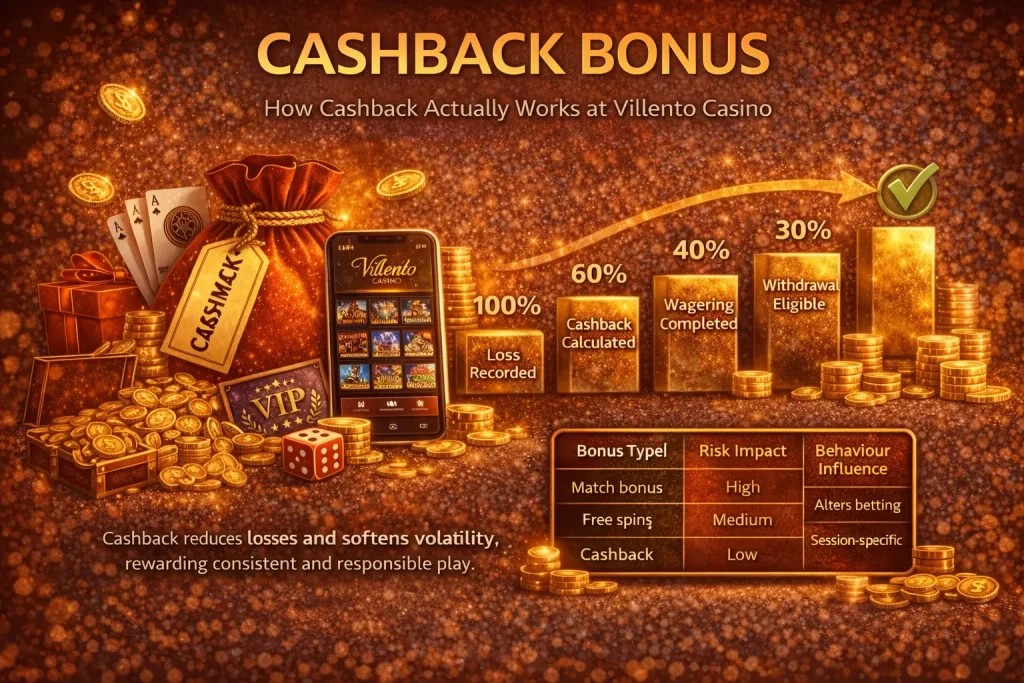
The chart demonstrates how only a portion of initial losses typically convert into withdrawable value — reinforcing why cashback should not be treated as guaranteed recovery.
Cashback and Responsible Gambling
Cashback is not designed to encourage higher risk. Its purpose is to soften volatility, not justify extended losses.
Responsible use principles:
- cashback should never justify chasing losses
- wagering limits should remain unchanged
- cashback should not reset emotional control
Players who increase stakes because “cashback will cover it” misuse the feature.
Cashback vs Other Bonus Types
Cashback differs structurally from other incentives.
| Bonus Type | Risk Impact | Behaviour Influence |
|---|---|---|
| Match bonus | High | Alters betting |
| Free spins | Medium | Session-specific |
| Cashback | Low | Stabilises play |
This is why cashback is often paired with loyalty programs rather than used as a headline promotion.
Long-Term Cashback Strategy
For regular players, cashback works best when:
- used consistently, not occasionally
- paired with stable bet sizes
- combined with loss limits
It should be seen as a background mechanic, not a target.
Common Cashback Misconceptions
Misunderstandings often include:
- expecting full loss recovery
- ignoring caps
- assuming instant withdrawals
- treating cashback as profit
Clear understanding prevents frustration and unrealistic expectations.
Cashback bonuses exist to reduce friction, not create excitement. When understood correctly, they reward consistency, discipline, and long-term engagement. When misunderstood, they become irrelevant or misleading.
Used properly, cashback is one of the few incentives that supports control rather than undermines it — and that is why it remains a core feature in mature casino ecosystems.