
How I Read Promotions as a System, Not as Advertising
When I look at promotions at Villento Casino, I do not treat them as marketing messages. I treat them as system signals. Each promotion reflects how the platform structures risk, engagement, and player behaviour over time. For players who have already completed Login and understand basic mechanics, promotions are less about excitement and more about predictability.
Promotions exist to shape when and how players interact with the platform. They are not designed to change odds or guarantee outcomes. They are designed to influence timing, pacing, and session structure.
From that perspective, a promotion is never isolated. It always exists in relation to:
- account status
- recent activity
- preferred game categories
- session duration
- device usage
Understanding this removes most confusion before it starts.
What Counts as a Promotion (and What Does Not)
Not every bonus is a promotion, and not every promotion involves extra balance. Promotions are time-bound or condition-bound incentives layered on top of normal play.
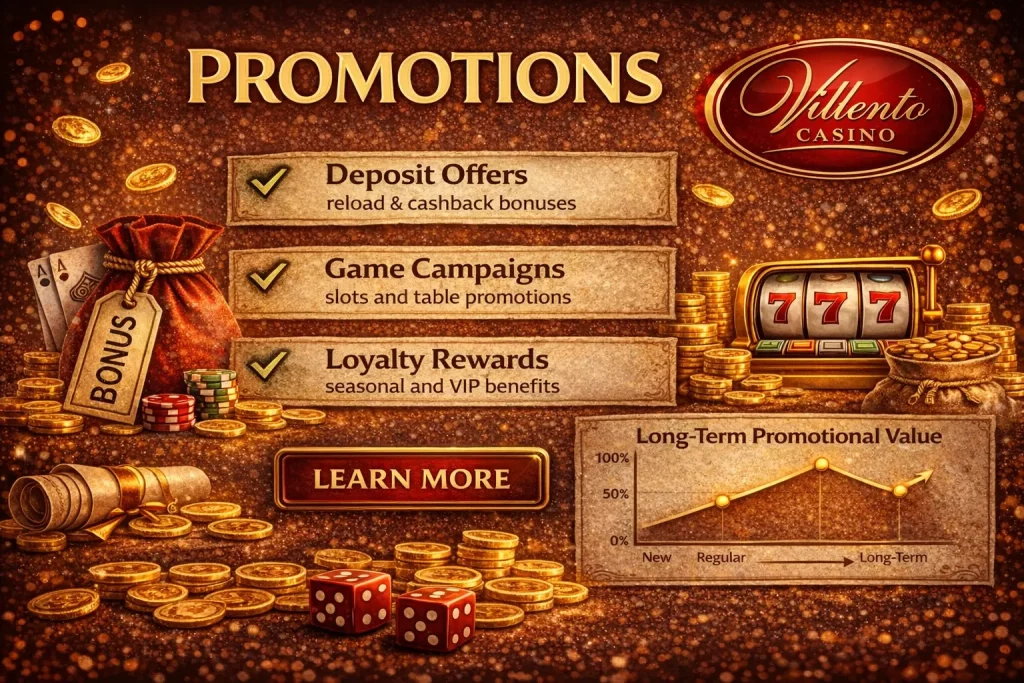
Typical promotion categories include:
- reload offers linked to deposits
- cashback periods
- game-specific campaigns
- loyalty-driven rewards
- seasonal or event-based offers
What matters is not the headline number, but the conditions under which the promotion activates and expires.
Core Promotion Types at Villento Casino
| Promotion Type | Trigger | Primary Function | Risk Profile |
|---|---|---|---|
| Reload bonus | Deposit activity | Extend session length | Medium |
| Cashback promotion | Net losses | Volatility smoothing | Low |
| Game campaign | Specific titles | Focused engagement | Medium |
| Loyalty promotion | Account history | Retention | Low |
| Time-limited offer | Calendar events | Activity timing | Medium |
Each of these promotions behaves differently once activated. Treating them as interchangeable is one of the most common player mistakes.
Promotions and Player Behaviour
Promotions are not passive. They subtly shape behaviour by introducing:
- deadlines
- wagering thresholds
- eligibility rules
- game restrictions
For example, a reload promotion may encourage a deposit, while a cashback promotion encourages completion of a session. Neither changes the game itself — they change decision context.
I always recommend evaluating a promotion using three questions:
- Does this promotion fit my usual play style?
- Does it require behaviour I would not normally choose?
- What happens if I ignore it completely?
If the answer to question two is “yes”, the promotion is likely not suitable.
Promotions vs Core Gameplay
Promotions sit on top of the platform, not inside it. Games, payouts, and mechanics remain unchanged whether a promotion is active or not. This distinction matters, especially for players focused on Slots or table games.
Promotions do not:
- increase RTP
- alter volatility
- change hit frequency
They only affect how balance is structured and how long a session can continue.
Promotion Efficiency by Play Style
Balanced sessions extract the most structural value from promotions because they allow wagering to progress without emotional pressure.
Why Promotions Are Optional by Design
One important observation: promotions are never mandatory. Players can deposit, play, and withdraw without activating any offer. This is intentional.
Forcing promotions would distort behaviour and increase support issues. Optionality keeps the system stable and allows experienced players to choose when incentives actually help.
Players who regularly ignore promotions are not penalised. In many cases, they receive fewer but more targeted offers later.
Promotions and Account Health
Promotion availability is closely linked to account health. Accounts that:
- complete wagering
- respect limits
- avoid disputes
- maintain consistent activity
tend to receive clearer, simpler promotions. Accounts that frequently cancel bonuses or violate terms tend to see fewer offers over time.
This is not judgement. It is system optimisation.
Promotions as Signals, Not Rewards
I do not see promotions as rewards for loyalty. I see them as signals indicating how the platform categorises my behaviour. Reading those signals helps me decide:
- when to play
- when to pause
- when to ignore incentives
That perspective removes urgency and restores control.
Deposit-Based Promotions, Reload Logic, and Early Account Cycles
When I analyse promotions that are tied to deposits, I always separate mechanics from motivation. Deposit-based promotions are not about generosity. They are about pacing. They exist to regulate how and when players add funds, especially after they have already completed Sign up and understand the basic structure of the platform.
These promotions are most often framed as reload bonuses, matched deposits, or limited-time top-ups. What matters is not the percentage itself, but how the promotion fits into an existing play rhythm.
How Reload Promotions Are Structured
Reload promotions are usually offered after a completed activity cycle. They are rarely attached to the very first deposit and are instead positioned as continuation tools.
From a system perspective, reload bonuses serve three purposes:
- encourage return play after withdrawals
- stabilise session length
- re-engage players without altering core risk
Unlike entry-level bonuses, reload promotions assume familiarity. They expect players to already understand wagering logic, eligible games, and withdrawal sequencing.
Typical Reload Promotion Formats
Below is a structural overview of how reload promotions are usually configured for existing players.
Reload Promotion Structures
| Reload Format | Deposit Match | Wagering Basis | Typical Use Case |
|---|---|---|---|
| Percentage match | 25–75% | Bonus only | Regular sessions |
| Fixed bonus | Flat amount | Bonus only | Controlled play |
| Tiered reload | Variable | Combined | High activity users |
| Time-limited reload | Fixed window | Bonus only | Reactivation |
What I consistently observe is that smaller, repeatable reloads outperform large, infrequent ones in terms of usability. Players make fewer mistakes when conditions are simple.
Reload Promotions and Behaviour Control
Reload bonuses subtly influence behaviour by introducing decision checkpoints. A player must decide:
- whether to deposit now or later
- whether the bonus fits the intended session
- whether wagering aligns with planned stakes
This friction is intentional. Promotions are designed to slow impulsive deposits, not accelerate them.
In that sense, reload bonuses act as behavioural filters. Players who deposit impulsively tend to struggle with wagering. Players who plan deposits tend to extract more value.
Deposit Timing and Promotion Availability
One detail many players overlook is timing. Promotions often activate based on when a deposit occurs, not how much it is.
Common timing triggers include:
- first deposit after withdrawal
- deposit after inactivity
- deposits during off-peak hours
- deposits within campaign windows
This explains why the same player may see different promotions on different days without any change in account status.
Promotions vs Base Deposits
I always compare a reload promotion against a clean deposit with no bonus attached. In many cases, playing without a promotion provides:
- faster withdrawals
- unrestricted game access
- complete stake flexibility
A reload promotion makes sense only if:
- wagering requirements align with planned play
- max bet rules do not restrict strategy
- session duration supports completion
Otherwise, skipping the promotion is often the rational choice.
Relationship Between Reload Promotions and Bonus History
Promotion availability is influenced by how previous bonuses were handled. Accounts that:
- complete wagering fully
- avoid cancelling bonuses mid-cycle
- respect promotion terms
tend to receive clearer reload offers over time. Accounts that frequently abandon bonuses often see fewer reload promotions and more cashback-type incentives instead.
This is not a reward system. It is a risk-balancing mechanism.
Reload Promotions and Game Selection
Reload bonuses often restrict eligible games more narrowly than general promotions. Slot-focused reloads, for example, may exclude table games entirely.
This is where understanding Bonus structure matters. A reload bonus tied to Slots should be evaluated differently than a flexible balance boost.
Players who ignore game restrictions risk invalidating wagering unintentionally.
Why Reload Promotions Are Optional
I consider it important that reload promotions remain optional. Forcing bonuses would increase disputes, errors, and support overhead. Optional promotions allow players to:
- opt in when conditions fit
- opt out without penalty
- maintain control over session structure
In practice, players who decline reload promotions occasionally often receive better-targeted offers later.
Promotions as Continuity, Not Incentive
Reload promotions do not exist to convince players to spend more. They exist to maintain continuity between sessions. Used correctly, they help smooth transitions between deposit cycles without increasing pressure.
Used incorrectly, they introduce complexity where none is needed.
Game-Specific Promotions and How Campaign Logic Shapes Play
When I examine promotions that are tied directly to games, I see the clearest example of how incentives are used to focus attention rather than increase risk. Game-specific promotions do not attempt to change how players behave globally. Instead, they guide activity toward particular formats, mechanics, or volatility profiles.
This is where promotions move from being general incentives to becoming precision tools.
Why Game-Specific Promotions Exist
Game-specific promotions appear when the platform wants to balance engagement across its catalogue. They are not random and they are not purely player-driven. From a system point of view, these promotions help to:
- distribute activity across different game categories
- reduce congestion in high-traffic formats
- introduce players to underused mechanics
- align bonus exposure with predictable behaviour
For players, the value lies in clarity. A promotion tied to a specific game or category usually comes with simpler wagering rules and fewer edge cases.
Typical Formats of Game-Linked Promotions
Below is a structured view of how these promotions are usually organised.
Game-Specific Promotion Structures
| Promotion Format | Eligible Games | Wagering Scope | Player Impact |
|---|---|---|---|
| Single-game bonus | One title | 100% contribution | Very focused |
| Category campaign | Slots / tables | Limited set | Medium focus |
| Feature-based promo | Mechanics (e.g. bonus rounds) | Defined titles | Controlled |
| Rotation campaign | Weekly game set | Changing pool | Exploratory |
What matters here is restriction, not freedom. The narrower the scope, the easier it is to predict outcomes and complete wagering without errors.
Promotions and Game Volatility
Game-specific promotions are often aligned with volatility profiles. Lower-volatility games are more commonly paired with wagering bonuses, while higher-volatility games are paired with cashback or capped promotions.
This alignment reduces the chance that players accidentally amplify risk while a promotion is active.
From my observation, promotions linked to Games with stable payout curves tend to deliver smoother progress and fewer disputes.
Campaign Duration and Rotation Logic
Game promotions are almost always time-bound. They appear, expire, and are replaced according to a rotation schedule. This serves two purposes:
- prevents long-term dependency on a single game
- encourages measured exploration without pressure
Short campaigns favour familiarity. Longer campaigns allow adaptation.
Campaign Duration vs Player Behaviour
| Campaign Length | Typical Behaviour | Risk Profile |
|---|---|---|
| 24–48 hours | Fast participation | Medium |
| 3–5 days | Planned sessions | Low |
| 7+ days | Gradual adaptation | Lowest |
Players who treat campaigns as optional windows rather than deadlines generally extract more value.
Promotions and Session Structure
Game-specific promotions work best when sessions are planned, not spontaneous. Because eligibility is narrow, players benefit from deciding in advance:
- which game the session will focus on
- how long the session will last
- whether wagering can be completed comfortably
This structure prevents mid-session switching, which is a common source of invalid wagering.
Interaction with Other Active Promotions
One important rule I always keep in mind: one promotion at a time. Game-specific promotions rarely stack cleanly with reload or cashback offers.
Activating a second promotion usually results in:
- cancellation of the previous bonus
- reset of wagering progress
- balance restructuring
This is not a flaw. It is a safeguard.
Players who try to optimise by overlapping promotions usually lose clarity rather than gain value.
Game Promotions as Learning Tools
Beyond immediate value, game-specific promotions serve an educational role. They allow players to:
- test unfamiliar mechanics under controlled conditions
- observe variance without full bankroll exposure
- identify which formats suit their pace and tolerance
From that angle, these promotions are less about profit and more about information acquisition.
When I Skip Game-Specific Promotions
I personally avoid game-specific promotions in three cases:
- when I want full freedom of game choice
- when session time is limited
- when volatility does not match my plan
Skipping a promotion does not reduce future eligibility. In many cases, it results in more relevant offers later.
The Strategic Value of Narrow Promotions
The narrower the promotion, the more predictable the outcome. That predictability is the real benefit for experienced players. Broad promotions promise flexibility but introduce complexity. Narrow promotions limit options but increase control.
Understanding that trade-off is essential for long-term play.
Seasonal Campaigns, Loyalty Promotions, and Long-Term Patterns
When I observe promotions over long periods, the most consistent value does not come from isolated offers. It comes from patterns. Seasonal campaigns and loyalty-driven promotions are built on accumulated account history rather than short-term triggers. These are the promotions that reflect how the platform recognises stable behaviour.
Unlike reloads or game-specific offers, long-term promotions are less reactive and more predictive.
Seasonal Promotions: Timing Over Intensity
Seasonal promotions appear around calendar events, platform milestones, or industry-wide periods of increased activity. Their purpose is not to push higher stakes, but to synchronise player engagement across time.
Typical characteristics include:
- extended validity periods
- moderate bonus values
- simplified wagering logic
- broad eligibility
Seasonal campaigns favour preparation rather than speed. Players who approach them calmly tend to complete wagering without disruption.
Seasonal Promotion Characteristics
| Season Type | Duration | Bonus Focus | Risk Level |
|---|---|---|---|
| Holiday events | 7–14 days | Balance extension | Low |
| Platform anniversaries | 5–10 days | Loyalty rewards | Low |
| Year-end campaigns | 10–30 days | Mixed incentives | Medium |
| Special events | Limited | Targeted play | Medium |
What I notice consistently is that longer campaigns reduce mistakes. Time pressure is one of the main sources of bonus-related issues, and seasonal promotions deliberately avoid it.
Loyalty-Based Promotions and Account History
Loyalty promotions differ from all other formats because they are cumulative. They reflect what a player has done over time rather than what they do in a single session.
Loyalty-driven promotions often consider:
- wagering completion rate
- consistency of deposits
- adherence to bonus rules
- withdrawal behaviour
- overall session stability
These promotions are not announced aggressively. They tend to appear quietly in the account interface and remain available longer than short-term offers.
Loyalty Rewards vs Standard Bonuses
I always separate loyalty rewards from standard bonuses. The expectations are different.
| Aspect | Standard Promotion | Loyalty Promotion |
|---|---|---|
| Trigger | Recent activity | Long-term behaviour |
| Duration | Short | Extended |
| Complexity | Medium | Low |
| Pressure | Higher | Lower |
| Predictability | Moderate | High |
Loyalty promotions rarely aim to maximise wagering volume. Instead, they aim to maintain engagement without disrupting balance.
Promotions and Account Maturity
As an account matures, promotion structure usually shifts:
- fewer high-percentage bonuses
- more cashback and fixed-value offers
- clearer eligibility rules
- longer validity windows
This is not a downgrade. It is an optimisation. Mature accounts benefit from stability more than from headline numbers.
Players who recognise this shift tend to experience fewer conflicts and smoother withdrawals.
Promotional Patterns Over Time
Value does not disappear over time. It changes form.
Promotions as Part of a Broader System
Promotions do not exist independently. They interact with:
- withdrawal policies
- responsible gambling tools
- account verification status
- game availability
Seeing promotions as part of this broader system prevents unrealistic expectations and reduces frustration.
Strategic View on Promotions
I treat promotions as optional modifiers, not as core gameplay. They work best when they align with existing habits rather than forcing new ones. Ignoring a promotion is often as valid as activating it.
For experienced players, promotions become less about excitement and more about alignment — alignment with timing, risk tolerance, and long-term control.
That perspective turns promotions from distractions into instruments.